Executive finding
Long-term studies comparing 10-year implant failure rate show that implant material, design, length, placement site, loading approach, and maintenance can all affect survival.
Titanium has the stronger and more consistent long-term evidence base, while outcomes for zirconia vary considerably between implant systems and generations.
A 2026 prospective multicentre study of a commercially available one-piece yttria-stabilised zirconia implant reported 97.7% estimated survival at 10 years, corresponding descriptively to about 2.3% cumulative non-survival.
In striking contrast, two other recent 10-year studies of older one-piece zirconia designs reported survival of only 73.3% and 59.26%, equivalent to approximately 26.7% and 40.74% cumulative non-survival.
Titanium long-term results are substantially more consistent in conventional indications. A 2023 randomised study reported 100% 10-year survival for both titanium implant systems examined, while a large 511-implant study found 98.8% survival and 97.0% success at 10 years.
Nevertheless, titanium is not immune to indication-related failure: a 2023 randomised trial found 10-year survival of 85.7% for 6-mm posterior implants versus 97.1% for 10-mm implants, illustrating that implant dimensions, anatomical site and biomechanics can alter outcomes independently of the fixture material.
The most defensible interpretation for research purposes is therefore:
Selected contemporary zirconia systems can approach titanium-like long-term survival, but material-level equivalence between zirconia and titanium has not yet been demonstrated in a adequately powered, direct 10-year randomised clinical trial. Titanium retains the stronger and more consistent long-term evidence base.
This conclusion is an inference from the available primary clinical studies rather than evidence from a single definitive 10-year zirconia-versus-titanium trial.
Scope, definitions and evidence strategy
This review prioritised human randomised trials and prospective clinical cohorts, concentrating on publications from approximately 2021–2026, while retaining older studies where necessary to provide genuine 10-year titanium benchmarks or the longest direct zirconia-versus-titanium comparison.
Studies concerning titanium-zirconium alloy were not treated as zirconia evidence: Ti-Zr is a metallic alloy, whereas the zirconia implants in this review are ceramic zirconium-dioxide fixtures.
This distinction is essential because combining Ti-Zr alloy data with ceramic zirconia would distort a material comparison.
“Survival”, “failure” and “success” must also be separated. Implant survival means the fixture remains in function; success normally applies additional biological, radiographic or technical criteria.
Consequently, a surviving implant can still have peri-implantitis, substantial marginal bone loss or prosthetic complications.
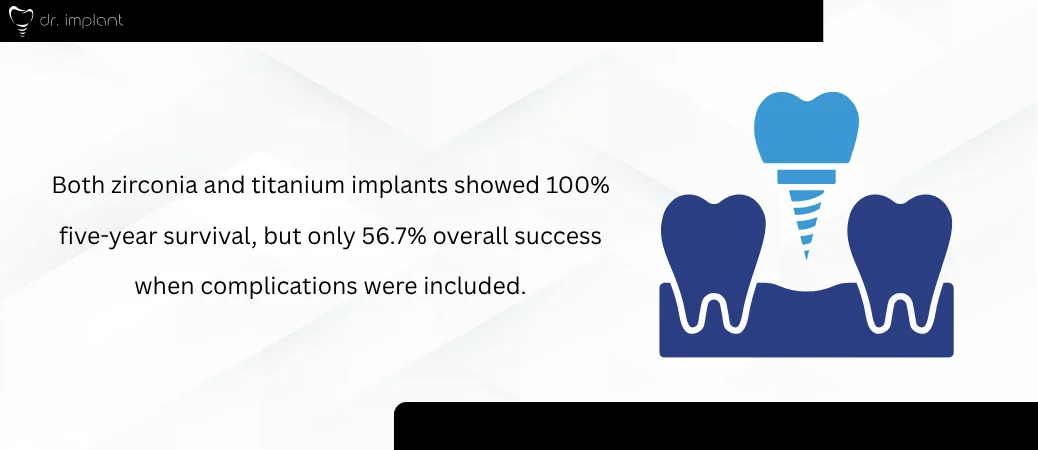
This distinction is demonstrated particularly clearly by the five-year zirconia-versus-titanium trial in which both groups had 100% survival, but overall success was only 56.7% once biological and mechanical complications were counted.
Where the table below expresses “approximate cumulative non-survival”, it is simply 100 minus the reported Kaplan–Meier/cumulative survival percentage.
It should not automatically be interpreted as the raw percentage of implants physically removed, because survival analyses can incorporate censoring and losses to follow-up.
Ten-year and near-ten-year clinical evidence
| Primary clinical study | Material and indication | Follow-up | Reported survival | Approx. non-survival | Key interpretation |
| Roehling et al., 2026 | Commercial one-piece Y-TZP zirconia, single-tooth gaps | 10 years | 97.7% | 2.3% | Best contemporary long-term zirconia result; 35 implants available at 10 years; success 91.4%. |
| Kohal et al., 2026 | One-piece zirconia, single-tooth reconstruction | 10 years | 73.3% | 26.7% | 16 of 66 implants lost; authors did not recommend this implant for routine use. |
| Kohal et al., 2025 | One-piece zirconia supporting three-unit FDPs | 10 years | 59.26% | 40.74% | 21 of 54 failed, mainly owing to peri-implantitis; studied fixture is no longer commercially available. |
| Herber et al., 2025 | Immediately temporised one-piece zirconia versus titanium | Up to 108 months | 62.2% Zr; 80.8% Ti | 37.8% Zr; 19.2% Ti | Small direct cohort using discontinued systems; numerical disadvantage for zirconia. |
| Gadzo et al., 2023 | Two titanium implant systems with fixed restorations | 10 years | 100% both groups | 0% | Survival remained excellent despite biological and technical complications. |
| Buser et al., 2012 | 511 SLA titanium implants | 10 years | 98.8% | 1.2% | Large long-term benchmark; success 97.0%, peri-implantitis prevalence 1.8%. |
The 97.7% 10-year zirconia result deserves particular attention. Roehling and colleagues followed 44 patients who received 44 commercially available, sandblasted-and-acid-etched Y-TZP implants for single-tooth replacement.
Thirty-five patients remained available for 10 years. Biological complications affected three of those 35 implants: two cases of mucositis and one of peri-implantitis.
Mean peri-implant bone loss was 1.20 ± 0.61 mm, and estimated success was 91.4%. The authors nevertheless emphasised the limited cohort size.
The poor Kohal results demonstrate why “the zirconia failure rate” cannot legitimately be represented by one pooled number without considering implant generation.
In their single-tooth cohort, 16 of 66 implants were lost over 10 years, giving 73.3% cumulative survival; the investigators explicitly concluded that the studied implant should not be recommended for routine clinical use.
In the three-unit FDP cohort, survival deteriorated from 98.1% at three years to 66.67% at five years and 59.26% at 10 years; failures were mainly associated with peri-implantitis. The implant concerned is no longer commercially available.
Titanium’s long-term record is considerably less heterogeneous in conventional designs. Gadzo et al. found 100% 10-year implant survival in both titanium systems, although technical complications occurred in 27.0% and 15.6%, mucositis in 29.7% and 50.1%, and peri-implantitis in 0% and 6.3%, respectively.
Thus, even excellent fixture survival does not imply complication-free treatment.
What recent direct comparisons show
Direct randomised evidence is shorter than the 10-year zirconia cohorts. The longest established head-to-head pilot trial followed two-piece implants for approximately 80.9 months.
Among the original 31 implants, two of 16 zirconia and one of 15 titanium implants were lost.
Among survivors there were no fixture or abutment fractures, and the investigators detected no significant material-related differences in the evaluated clinical and radiographic parameters; however, only 22 patients were initially enrolled, severely limiting statistical power.
A particularly informative 2024 randomised trial followed 16 one-piece zirconia and 14 titanium implants for five years in the anterior maxilla.
There were no implant losses in either group. Yet biological complications occurred in 31.25% of zirconia and 35.70% of titanium implants, including peri-implantitis in 18.75% and 14.28%, respectively. Both groups also recorded three crown-debonding events.
The authors found no statistically significant intergroup difference and reported success of roughly 55.6% for zirconia versus 57.8% for titanium.
Not all modern trials are equally reassuring. In a 2025 randomised trial of 60 patients, the zirconia group experienced three early failures plus three subsequent losses related to insufficient osseointegration.
Its cumulative survival was 10.7 percentage points below titanium, whose survival was 100%, and prespecified non-inferiority was not demonstrated.
Importantly, technical crown complications were uncommon; the central problem was implant integration rather than zirconia fixture fracture.
A 2026 three-year split-mouth trial in 20 edentulous patients similarly reported 100% titanium versus zirconia survival (97.22%)l, but the difference was greater for success: 91.70% versus 77.78%, with significantly greater marginal bone loss around zirconia implants at 36 months.
Conversely, another multicentre trial published in 2026 reported 100% one-year zirconia survival versus 96.5% for titanium, with no statistically significant differences in survival, marginal bone loss or peri-implant health, reinforcing the fact that short-term results vary by system and protocol rather than following a universal material hierarchy.
Why failure rates vary so widely
The clinical data indicate that implant material alone is an inadequate predictor of failure.
Fixture design, surface engineering, one-piece versus two-piece construction, restoration type, loading strategy, implant length, anatomical location and maintenance protocol all change the risk environment.
This is strongly illustrated within titanium itself: in the 2023 posterior single-crown RCT, 6-mm implants had 85.7% 10-year survival compared with 97.1% for 10-mm implants, with most losses attributed to late loss of osseointegration rather than peri-implantitis.
For zirconia, the major long-term concern emerging from the worst-performing cohorts is not simply ceramic fracture.
The 10-year three-unit study attributed most failures to peri-implantitis, while the 2025 randomised trial identified insufficient osseointegration as the reason for post-baseline losses.
In the approximately 80-month direct pilot trial, no surviving zirconia or titanium fixture or abutment fractured. Therefore, portraying zirconia failure primarily as a “brittleness/fracture problem” would not accurately reflect these recent clinical datasets.
The dramatic difference between 97.7% and 59.26% 10-year zirconia survival is therefore clinically meaningful but should not be interpreted as contradictory science.
The better-performing study involved a commercially available, surface-modified Y-TZP implant used for single-tooth gaps, whereas the lowest-performing study involved a different, now-discontinued one-piece design supporting three-unit fixed prostheses.
The evidence consequently supports system-specific evaluation rather than class-wide extrapolation.
South Florida relevance and evidence beyond 2026

For the requested U.S. focus, Miami, Pembroke Pines and Delray Beach, the searches conducted for this review did not identify a published city-specific 10-year zirconia-versus-titanium comparative cohort or randomised trial.
Miami does have historical implant research: a University of Miami clinical study investigated rough acid-etched titanium-alloy implants, but its follow-up was approximately one year rather than 10 years and it provides no zirconia comparator.
It therefore cannot be used to calculate a South Florida zirconia-versus-titanium failure ratio.
This gap means that applying the global evidence to Pembroke Pines, Delray Beach or Miami should be treated as external clinical evidence, not as a locally measured failure rate.
A rigorous South Florida research project should record the exact implant manufacturer/generation, zirconia composition, one- versus two-piece design, diameter and length, tooth position, augmentation, immediate versus delayed loading, smoking, periodontal history, peri-implant maintenance, peri-implantitis and prosthetic complications, with survival and strict success reported separately.
The substantial between-study variation demonstrated above makes such stratification methodologically necessary.
Evidence will continue to mature after 2026. An official ClinicalTrials.gov five-year extension, NCT05326880, is designed to compare two-piece zirconia with titanium implants and includes implant survival and complication-free survival among its longitudinal outcomes; its registry timetable extends into 2027–2028.
It is therefore particularly relevant to future updates of this review, although it cannot currently resolve the 10-year evidence gap.
Overall, titanium currently offers the more predictable long-term evidence base, commonly reaching roughly 97–100% 10-year survival in conventional, well-maintained indications, while zirconia ranges from titanium-like performance in selected modern systems to unacceptably high failure in particular legacy designs.
The scientifically appropriate conclusion is therefore not that zirconia “fails more”, but that 10-year equivalence to titanium has yet to be established at the material-class level.
Current evidence justifies carefully selected zirconia systems as viable alternatives while supporting titanium as the benchmark against which future ceramic implant systems should continue to be tested.
At Dr. Implant, long-term treatment planning considers more than implant material alone, including bone health, implant design, placement, bite forces, and the maintenance needed to support lasting results.
References