If your dentist says a tooth needs to come out but you’re not ready for a dental implant, you may still have a way to protect your future options.
Bone grafting after tooth extraction can help preserve jawbone volume while you decide when or whether to replace the missing tooth.
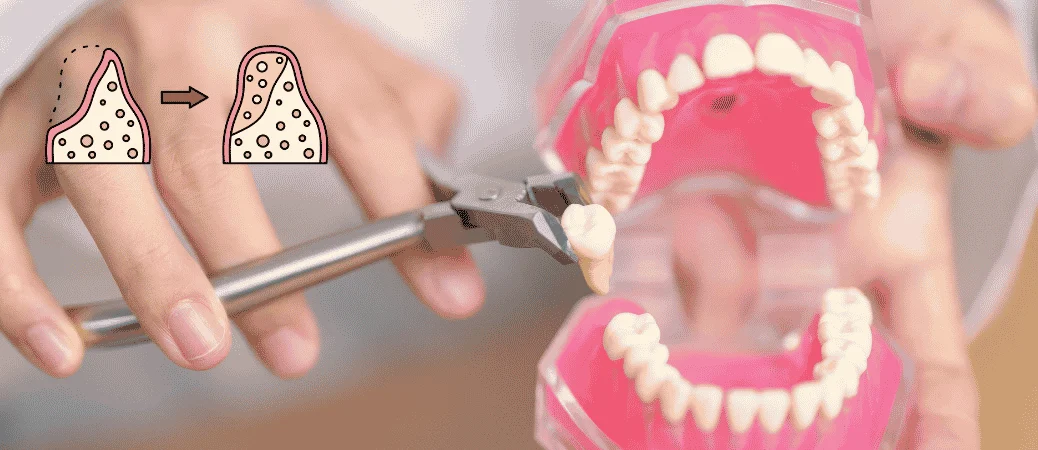
This procedure, called socket preservation, places graft material into the empty tooth socket to reduce the bone shrinkage that naturally follows extraction.
It doesn’t guarantee that you’ll qualify for an implant later, and not every extraction requires grafting. However, it may reduce the need for more extensive bone rebuilding if you choose an implant in the future.
This decision comes up constantly in dental offices: a tooth needs to go now, money or timing means the implant has to wait, and nobody wants to find out in two years that waiting cost them options.
Key Takeaways
- Bone grafting at extraction is not mandatory for every tooth, but it can protect your ability to get an implant later.
- The jawbone changes fastest in the first few months after extraction, which is why the graft-or-no-graft decision usually needs to happen right away.
- Even without a graft, many people still qualify for an implant later; it may just require more prep work and healing time.
Should You Get a Graft If You Are Delaying an Implant?
Getting a graft now makes the most sense if you think you will want an implant someday and your dentist sees signs the socket will collapse more than usual.
It is not an automatic yes for every extraction, and it is worth a short conversation with your oral surgeon before you decide either way.
When Does Socket Preservation Help Keep Implant Options Open?
A bone graft helps most when the socket has lost part of its wall, when the tooth sat in thin bone to begin with, or when you have gum disease that has already eaten away some support.
In these cases, the socket is more likely to cave in on itself during healing, narrowing the ridge in ways that make delayed implant placement harder later.
Front teeth are a common example, since the bone there tends to be thin and any collapse shows up in your smile.
If you already know you want an implant eventually, grafting at the time of extraction is widely seen as the most effective way to protect that bone.
When Might a Graft Be Unnecessary?
A graft may be less necessary when the surrounding bone is healthy, the socket walls are intact, and the expected bone changes are unlikely to affect future treatment.
However, the decision depends on the tooth’s location, the condition of the socket, and your long-term replacement plans.
If gum disease or infection are not involved and the socket looks clean on examination, some dentists will tell you healing on its own is a reasonable choice.
This is a conversation to have chairside, not a decision to make from an article, since your oral surgeon can see the socket walls in a way no guide can describe for you.
What Should You Ask Before the Tooth Is Removed?
Before the extraction, ask your dentist or oral surgeon a short list of pointed questions:
- Are any of the socket walls thin, cracked, or missing on the CBCT scan or cone beam CT scan?
- Based on what you see, how much bone do you expect me to lose if I skip grafting?
- If I wait a year or two for the implant, will I likely need a second grafting procedure anyway?
- What would my tooth replacement options look like, including removable dentures, if the ridge shrinks more than expected?
- What does the graft cost now versus what a future ridge rebuild might cost?
Write down the answers. They will matter more once you are actually scheduling the implant.
What Happens to the Jawbone While You Wait?
The jawbone around a missing tooth starts shrinking almost immediately, and most of that change happens in the first several months.
This is not something you will feel happening, but it is measurable on imaging, and it is the whole reason the graft-or-no-graft decision cannot wait.

How Quickly Does the Ridge Change After Extraction?
Bone loss begins the moment the tooth and root come out. In the first week, a blood clot forms and your body starts clearing away bone that no longer serves a purpose.
Most of the early height and width loss happens in the first three to six months. After that, the pace slows, but the alveolar ridge keeps remodeling for months and sometimes years.
The outer wall of bone, the part closest to your cheek or lip, tends to shrink more than the inner part, which is why width loss often outpaces height loss.
The bone surrounding a tooth root helps support the tooth and responds to normal chewing forces. After extraction, the socket heals and the surrounding bone naturally remodels.
During this process, the ridge often becomes narrower and may lose height, particularly during the first several months.
Can a Socket Graft Prevent All Bone Loss?
No bone graft can prevent bone loss completely. Instead, socket grafting helps reduce shrinkage and preserve more of the jawbone’s original shape as the extraction site heals.
Studies comparing grafted and non-grafted sockets generally show less bone loss with grafting, although some natural remodeling still occurs.
Understanding the effects of bone loss before dental implants can help you decide whether socket preservation is worth considering.
The goal is not to eliminate bone loss entirely but to maintain enough bone volume to support future tooth replacement options.
What Happens During Socket Preservation?
Socket preservation means your dentist or oral surgeon fills the empty socket with graft material right after the tooth comes out, then protects it while it heals.
The appointment itself does not take much longer than a standard extraction, and most of the real work happens over the following months as your body incorporates the graft.
How Is the Tooth Socket Grafted and Protected?
After tooth extraction, your dentist cleans the socket and removes any infected or damaged tissue. Graft material is then placed into the empty space to help preserve the surrounding bone.
Depending on the condition of the socket and the grafting technique, your dentist may cover the area with a protective membrane or collagen dressing. Stitches may also be used to secure the tissues or protective material.
You’ll receive aftercare instructions to protect the graft while the extraction site heals.
Which Graft Materials Might Your Dentist Use?
A few material types show up most often in socket grafting:
| Graft Type | Source | Common Use |
| Autograft | Your own bone | Smaller defects, highest biologic compatibility |
| Allograft | Human donor tissue | Common first choice for routine socket preservation |
| Xenograft | Animal source (often bovine) | Slower resorption, used to hold space longer |
| Alloplast | Synthetic material | Avoids donor tissue, consistent supply |
Some dentists use platelet-rich fibrin (PRF), prepared from a small sample of the patient’s blood, alongside grafting materials.
PRF contains platelets and growth factors that may support early tissue healing, although its benefits vary depending on the procedure and available clinical evidence.
What Is Normal During Early Healing?
Mild swelling, some tenderness, and minor oozing for a day or two are expected. You should be back to normal daily activity within about a week, though the bone itself keeps maturing for months afterward.
Contact your dentist if you notice heavy bleeding, a fever, or pain that keeps getting worse instead of better.
When Can You Get an Implant After Grafting?
After socket preservation, many patients can be evaluated for implant placement within about three to six months.
However, some sites need additional healing time, especially when extensive bone grafting was required.
Your dentist will assess bone volume, healing progress, and overall implant readiness before deciding when to proceed.

How Does Your Dentist Decide the Site Is Ready?
Your dentist may use X-rays or a CBCT scan to assess the amount and shape of bone available for implant placement. Imaging helps with treatment planning, but it cannot confirm bone strength or implant stability on its own.
Your dentist will also consider healing progress, medical history, and the condition of the surrounding tissues before recommending the next step.
Waiting too long past the healing window is not free, either. Once a graft has matured, the site still needs the mechanical stimulation of an implant or tooth root to hold its shape, and delaying further can mean some of that hard-won bone starts to shrink again.
How Does Delayed Placement Compare with an Immediate Implant?
An immediate implant is placed on the same day as the tooth extraction, potentially shortening the overall treatment timeline.
However, this approach is not suitable for every patient, especially when the extraction site lacks sufficient bone support or has other complications.
Delayed placement allows the extraction site and any bone graft to heal before the implant is inserted. Your dentist will evaluate the healing progress and use imaging when appropriate to determine whether the site is ready.
Understanding the differences between delayed placement and immediate dental implants after extraction can help you see how bone condition, implant stability, and individual treatment needs influence the recommended approach.
What Happens Between Implant Placement and the Final Tooth?
Once the implant is placed, it typically needs several months to fuse with the surrounding bone before it can support a permanent crown. This process, called osseointegration, is an important part of implant stability.
Your dentist will monitor healing and confirm that the implant is ready before placing the final restoration.
The overall timeline can vary depending on your bone health, whether grafting was needed, and other factors affecting recovery.
Understanding bone graft healing time for dental implants can help you see how the grafting and implant healing stages fit into the treatment process.
What If You Skip the Graft or Need More Bone Later?
Skipping the graft does not rule out an implant later, it just means more rebuilding may be needed before one can go in.
The procedures used to rebuild a shrunken ridge are well established, just more involved than socket preservation would have been.
Which Procedures Can Rebuild a Ridge After It Shrinks?
Ridge augmentation adds bone width or height back to a ridge that has already narrowed.
Guided bone regeneration pairs a bone graft with a membrane to direct new bone growth into a specific defect, often used when the ridge has collapsed unevenly.
For upper back teeth, where the sinus floor sits close to the jaw, a sinus lift (sinus augmentation) may be recommended when there isn’t enough vertical bone to support an implant.
The procedure creates additional space for bone grafting, helping prepare the area for future implant placement.
Could You Still Need More Grafting After Socket Preservation?
Yes. Even a well-healed socket graft does not guarantee the site will be ready for an implant without any further work.
Bone defects can still show up on imaging, especially if healing took longer than expected or the original damage to the socket wall was more extensive than it looked at the time of extraction.
How Do Costs and Insurance Affect the Decision?
Grafting now is generally less involved, and often less costly, than rebuilding a collapsed ridge with augmentation or a sinus lift later.
Dental insurance plans vary widely in what they cover for either procedure, so it is worth checking your specific plan before deciding to wait.
If cost is the main reason you’re delaying implant treatment, exploring dental implant financing options can help you understand available payment arrangements before ruling out future tooth replacement.
Deciding Now Without Committing to an Implant

You can choose a bone graft after tooth extraction without committing to a dental implant, bridge, or another replacement option.
A socket preservation graft can help reduce bone loss, keeping future treatment options open, although it cannot prevent all bone changes.
Think of the decision in two steps. First, your dentist evaluates whether a bone graft makes sense based on the condition of the socket, the tooth’s location, and your possible future treatment needs.
The second decision involves choosing how to replace the missing tooth, which can happen when you’re ready.
If you’re still exploring your tooth replacement options, you don’t have to make that decision on the same day as your extraction.
At Dr. Implant, our team can help you evaluate whether preserving the bone now makes sense while giving you time to decide on the right tooth replacement for your needs.
Frequently Asked Questions
How long can I wait to get a bone graft after tooth extraction?
Socket preservation grafting needs to happen at the time of extraction or very soon after, since it is designed to fill the socket before the body starts reshaping it.
Once significant healing has occurred, usually within a matter of weeks, the opportunity for simple socket preservation has largely passed, and a different kind of bone grafting would be needed instead.
What happens if I do not get a bone graft when my tooth is pulled?
The socket will still heal, but the ridge often ends up narrower and shorter than it would have with a graft, especially in the first three to six months.
This does not rule out an implant later; it may just mean more preparation, like ridge augmentation, before one can be placed.
Is throbbing pain normal after an extraction and bone graft?
Mild to moderate discomfort and some swelling are normal for the first few days. Pain that keeps intensifying instead of easing, especially alongside fever or heavy bleeding, is not typical and is worth calling your dentist about right away.
What should I do if the bone graft membrane starts coming out?
Call your dentist’s office the same day rather than waiting it out. A membrane that shifts or becomes exposed can sometimes be managed in the office without losing the graft, but it needs a professional look rather than a guess at home.
Does a bone graft increase the risk of dry socket?
Grafting itself does not inherently raise dry socket risk, though any surgical site needs proper aftercare to protect the healing clot.
Following your dentist’s instructions on rinsing, smoking, and diet matters just as much after a graft as after a standard extraction.