Getting a dental bone graft can feel overwhelming, especially when you’re not sure what to expect during recovery. You might be wondering how long the healing takes and what happens at each stage.
The complete healing timeline for bone grafting typically ranges from three to six months, though you’ll notice improvements much sooner as your body progresses through distinct stages of recovery.
The healing process starts immediately after your procedure and moves through several phases. Understanding the bone graft healing stages week by week helps you know what’s normal and when to contact your dentist.
During the first few days, you’ll focus on managing swelling and protecting the graft site, while the real bone integration work happens gradually over the following months.
Knowing what happens at each stage helps you take better care of yourself and sets realistic expectations for your recovery.
The bone graft healing time for dental implants can vary based on your health, the type of graft material used, and how well you follow your dentist’s instructions.
This guide walks you through each phase so you can feel confident about your healing journey.
Key Takeaways
- Dental bone graft healing takes three to six months for complete recovery and bone maturation
- The healing process includes four main stages from initial clot formation to final bone integration
- Following proper post-operative care and maintaining good oral hygiene directly impacts your recovery success
Table of Content
- Understanding Dental Bone Grafts and Their Purpose
- Types of Graft Materials and Their Impact on Healing
- Key Stages of Dental Bone Graft Healing
- Factors That Influence Bone Graft Recovery
- Caring for Your Dental Bone Graft After Surgery
- Frequently Asked Questions
Understanding Dental Bone Grafts and Their Purpose
A dental bone graft adds bone material to your jaw when it has become too thin or weak. This procedure helps create a strong foundation for dental implants and protects your overall jawbone health.
What Is a Dental Bone Graft?
A dental bone graft is a type of oral surgery that increases the volume and density of your jaw. Your dentist adds powdered bone grafting material to areas where you have lost or thinning bone.
The bone material can come from different sources. Some grafts use your own bone from another part of your body. Others use processed bone from donors or animals. Lab-made materials are also available.
During the bone graft procedure, your dentist places this material into the affected area of your jawbone. Over time, the graft material bonds with your natural bone and encourages new bone growth.
Why Bone Grafting Is Needed for Jawbone Health
Your jawbone needs stimulation from tooth roots to stay strong and healthy. When you lose teeth, the bone in that area starts to shrink and weaken.
This process can change the shape of your face and make it harder to eat or speak properly.
Bone grafting stops this bone loss and rebuilds what you’ve already lost. Socket preservation is a common type of graft done right after tooth extraction to prevent bone shrinkage.
Ridge augmentation rebuilds the bone along your jaw ridge where teeth are missing.
A sinus lift adds bone to your upper jaw near your molars and premolars. This type of graft is needed when your sinuses are too close to your jaw for safe implant placement.
Preparing for Dental Implants With Bone Grafting
Dental implants need strong, thick bone to stay secure in your jaw. Without enough bone, your tooth implant could fail or fall out. That’s why bone grafting often comes before implant placement.
The graft creates a solid base that can support your implant for many years. Your dentist will evaluate your jawbone density to determine if you need grafting before getting dental implants.
Once your bone graft heals completely, you can move forward with implant surgery. The timing matters though. It’s best to get your dental implant within six to 12 months after your bone graft heals, or the new bone may start to shrink again.

Types of Graft Materials and Their Impact on Healing
The type of bone graft material your surgeon chooses plays a major role in how quickly your bone heals and how successful the procedure will be.
Each material has different properties that affect the healing timeline and the quality of new bone growth.
Autograft, Allograft, Xenograft, and Alloplast Options
An autograft uses bone taken from another area of your own body, such as your hip, jaw, or tibia. This is considered the gold standard because it contains living bone cells and growth factors that promote healing.
Your body won’t reject autograft material since it comes from you.
An allograft uses donated human bone from a tissue bank. The bone goes through processing to remove cells and reduce the risk of disease transmission.
While allografts don’t contain living cells, they still provide a framework for your new bone to grow on.
A xenograft comes from animal sources, typically cows or pigs. The material is processed to remove organic components while keeping the mineral structure intact. This gives your body a scaffold to build new bone around.
An alloplast is a synthetic bone graft material made from substances like calcium phosphate or bioactive glass. These bone graft substitutes are manufactured in a lab and designed to mimic natural bone structure.
How Graft Material Affects Bone Regeneration
The graft material you receive determines how your body approaches bone regeneration. Autografts typically heal fastest because they’re osteoinductive, meaning they contain proteins and cells that actively trigger new bone formation.
They’re also osteoconductive, providing a structure for bone cells to grow along.
Allografts and xenografts are mainly osteoconductive. They act as a framework but rely on your body’s own cells to create new bone. This usually means a longer healing timeline compared to autografts.
Alloplast materials vary in their properties. Some are purely osteoconductive, while newer synthetic options include added growth factors to boost healing.
The bone grafting materials you receive will be bioresorbable, meaning they gradually break down as your natural bone replaces them.
Choosing the Right Bone Graft Material
Your doctor considers several factors when selecting your bone graft material. The location and size of the bone defect matter significantly.
Large defects often need autografts for the best results, while smaller areas may heal well with other options.
Your overall health and healing ability influence the choice. If you have diabetes or other conditions that slow healing, your surgeon might prefer autograft for its superior healing properties.
The various types of bone grafts each have specific advantages depending on your situation.
Cost and availability also play a role. Autografts require a second surgical site, which adds time and discomfort. Allografts and synthetic options avoid this extra surgery but may cost more or have longer healing times.
Key Stages of Dental Bone Graft Healing
Your bone graft healing follows a predictable pattern that starts with blood clot formation and ends with fully mature bone ready for an implant.
The entire bone graft healing timeline typically spans three to six months, with each stage building on the previous one to create strong, stable bone tissue.

Immediate Healing and Clot Formation
Right after your dental bone graft procedure, your body forms a blood clot at the surgical site. This clot acts as a protective layer over the graft material and starts the healing process.
During the first 24 to 48 hours, the clot stabilizes and prevents bacteria from entering the wound. You’ll notice swelling and some discomfort during this time, which is your body’s normal response to surgery.
Blood clot formation happens within the first week after your procedure. This stage is critical because the clot contains special cells that will later transform into bone-building cells.
If you lose the clot too early, you may develop a painful condition called dry socket.
Keep the surgical area undisturbed during these first few days. Avoid rinsing forcefully, drinking through straws, or touching the area with your tongue.
Early Bone Formation and Vascularization
Between weeks two and four, new blood vessels grow into the graft site. This process, called vascularization, brings oxygen and nutrients that your healing bone needs.
Your body starts replacing the blood clot with soft, immature bone tissue. Special cells called osteoblasts begin depositing minerals around the graft material.
You may still have some swelling during this phase, but pain should be minimal.
The soft tissue typically closes within two to four weeks after surgery. Your gums heal over the graft, protecting it while the bone underneath continues developing.
During this early bone formation stage, the graft material provides a framework for your natural bone to grow around.
Bone Regeneration, Integration, and Maturation
From months one through three, your body enters the active bone regeneration phase. The graft material gradually integrates with your existing jawbone through a process called osseointegration.
New bone cells continue multiplying and hardening. The bone becomes denser and stronger each week. By month three, you have significant new bone growth, though it’s not yet fully mature.
Bone maturation continues through month six and sometimes beyond. Your jawbone typically strengthens over 2-6+ months as the graft bonds completely with your natural bone.
The final bone structure can support the pressure of chewing and is ready for dental implant placement.
Your dentist will take X-rays during follow-up visits to confirm proper bone integration before moving forward with implants.
Understanding the Bone Graft Healing Timeline
Your complete bone graft healing time depends on several factors. The size and location of your graft affect how long recovery takes.
Factors that influence healing:
- Type of graft material – Your own bone typically integrates faster than synthetic materials
- Overall health – Conditions like diabetes can slow bone graft recovery
- Smoking status – Tobacco use significantly delays healing
- Age – Younger patients often heal more quickly
Most patients return to normal activities within a few days after surgery. However, the bone itself typically needs 3 to 6 months to become dense enough for an implant.
Your dentist will give you a personalized timeline based on your specific case. Following post-operative instructions carefully helps ensure your bone graft healing stages progress smoothly and on schedule.
Factors That Influence Bone Graft Recovery
Your bone graft recovery depends on multiple factors that can speed up or slow down healing.
Individual health conditions, lifestyle choices, surgical methods, and potential complications all play important roles in how well your graft integrates with existing bone.
Health, Habits, and Healing Speed
Your overall health significantly affects how quickly you heal after bone graft surgery. If you have diabetes, your body may take longer to build new bone tissue because high blood sugar levels can slow down cell growth and repair.
Autoimmune conditions like rheumatoid arthritis or lupus can also interfere with the natural healing process.
Age matters too. Younger patients typically experience faster bone graft healing because their bodies produce bone cells more actively. If you’re over 60, expect your recovery to take a bit longer than the standard timeline.
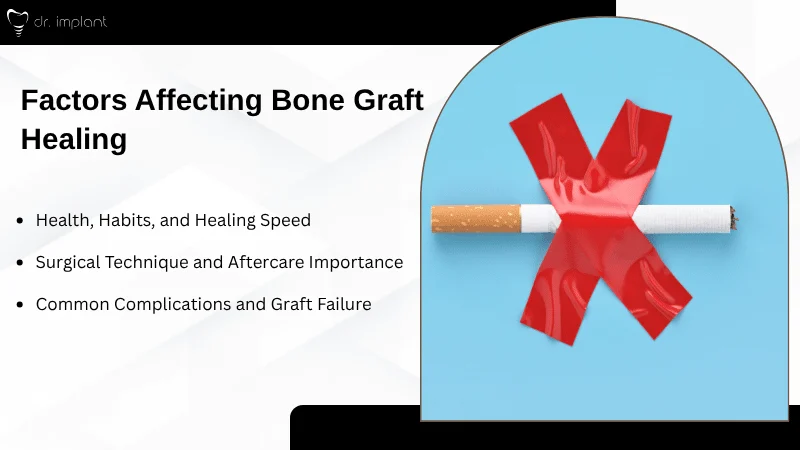
Smoking is one of the biggest obstacles to successful healing. Tobacco restricts blood flow to the graft site, which means less oxygen and fewer nutrients reach the area where new bone needs to form.
This increases your risk of graft failure substantially.
Your nutrition choices directly impact recovery speed. Eating enough protein helps your body build new tissue, while calcium and vitamin D strengthen developing bone.
If you’re not getting adequate nutrition, your bone graft recovery timeline may extend beyond typical expectations.
Surgical Technique and Aftercare Importance
The graft material and technique your dentist uses affects how quickly healing occurs. Autografts (bone from your own body) typically integrate faster than synthetic materials because your body recognizes them as natural tissue.
The size and location of your graft also matter. Smaller grafts in areas with good blood supply heal more quickly than large grafts placed in areas with limited circulation. A single-tooth site recovers faster than a full sinus lift procedure.
Following post-operative instructions is critical for success. You need to avoid disturbing the surgical site during the first few weeks when the initial blood clot forms and protects the graft.
Eating soft foods, taking prescribed antibiotics, and maintaining gentle oral hygiene all support proper healing.
Skipping follow-up appointments can lead to undetected problems. Your dentist monitors healing progress and catches early warning signs of complications before they become serious issues.
Common Complications and Graft Failure
Infection represents the most common reason for graft failure. Signs include persistent pain after the first week, swelling that worsens instead of improves, fever, or discharge from the surgical site.
If you notice these symptoms, contact your dentist immediately because early treatment can often save the graft.
Graft exposure happens when the tissue covering your bone graft breaks down and the graft material becomes visible in your mouth.
This occurs in about 5-10% of cases and usually requires additional treatment to protect the healing bone.
Your body may occasionally reject synthetic graft materials, though this is rare.
Rejection causes ongoing inflammation and prevents proper bone formation. In these cases, your dentist may need to remove the failed graft and try again with a different material.
Inadequate blood supply to the graft site prevents new bone from forming properly. This happens more often in patients who smoke or have circulatory problems.
Caring for Your Dental Bone Graft After Surgery
Following proper care steps after your bone graft procedure helps your body heal correctly and prevents problems.
Knowing what to expect during recovery and when to contact your dentist keeps you on track for successful dental bone graft healing.

Post-Operative Instructions for Success
Your dentist will give you specific post-operative instructions to follow right after your bone graft procedure. Take all prescribed medications exactly as directed, including antibiotics to prevent infection and pain relievers to manage discomfort.
First 24-48 Hours:
- Apply ice packs to your face for 20 minutes on, 20 minutes off
- Avoid rinsing, spitting, or drinking through a straw
- Keep gauze on the surgical site and bite gently
- Rest with your head elevated on pillows
Diet Changes:
- Stick to soft foods like yogurt, mashed potatoes, and smoothies for the first week
- Avoid hot liquids for the first 24 hours
- Don’t eat crunchy, hard, or chewy foods that could disturb the graft
- Stay hydrated by drinking plenty of water
After 24 hours, gently rinse your mouth with warm salt water (one teaspoon of salt in eight ounces of water) several times daily. Brush your other teeth carefully but avoid the surgical area for the first few days.
Signs of Healthy Healing Versus Complications
Normal healing includes some swelling, minor bleeding, and discomfort for the first few days. Your gums may look slightly red or bruised around the surgical site. Light oozing mixed with saliva is common during the first 24 hours.
Healthy Healing Signs:
- Swelling that peaks around day 2-3 then decreases
- Pain that improves each day
- Minimal bleeding that stops with gentle pressure
- White or yellowish tissue forming over the graft site
Warning Signs Requiring Immediate Attention:
- Heavy bleeding that doesn’t stop after 30 minutes of pressure
- Severe pain that worsens instead of improving
- Fever above 101°F
- Pus or foul-smelling discharge from the surgical site
- Graft material falling out
- Numbness lasting more than a few hours
Contact your dentist right away if you notice any of these complications. Early treatment prevents bone graft healing problems.
Timeline for Returning to Normal Activities
Most people return to work or school within 2-3 days after their bone graft procedure. Your activity level should gradually increase as you feel better.
Days 1-3: Rest at home and avoid physical activity. No bending over, lifting heavy objects, or strenuous exercise.
Days 4-7: You can resume light activities like walking. Avoid touching the surgical area with your tongue or fingers.
Week 2-4: Return to most normal activities but skip intense workouts or contact sports. You can start eating slightly firmer foods as comfort allows.
Month 1-3: Resume all regular activities including exercise. The bone graft is actively bonding with your natural jawbone during this time.
Wait at least 72 hours before smoking or using tobacco products, though quitting entirely gives you the best healing results. Alcohol should be avoided for at least one week or until you finish your antibiotics.
Frequently Asked Questions
Most people want to know when they can get their implant and what healing looks like in the early days. The timing depends on your graft size, the material used, and your overall health.
How long does it usually take for a bone graft to heal before the next step?
You’ll typically wait 3 to 6 months before getting your dental implant. Small grafts for a single tooth often heal in 3 to 4 months, while larger grafts like sinus lifts may need 5 to 6 months or longer.
Your dentist will use X-rays to check if your bone has grown enough to support an implant. The bone needs to become dense and stable enough to hold the implant in place.
Some factors can speed up or slow down this timeline. Younger patients often heal faster than older ones. If you smoke or have diabetes, you might need extra healing time.
What are the typical healing stages after a dental bone graft, day by day?
The first week brings swelling and discomfort that peaks around day 2 or 3. You’ll notice some bruising and mild bleeding during the first 24 to 48 hours after your procedure.
Days 3 to 7 show gradual improvement. Your swelling starts to go down, and pain becomes easier to manage with medication.
During weeks 2 to 6, your body builds soft tissue around the graft. The area begins to feel firmer, and you can slowly add more foods to your diet.
Weeks 6 to 12 mark the hard bone formation stage. Your graft site feels solid when you gently touch it, and the bone starts to look mature on X-rays.
Months 3 to 6 involve bone remodeling. Your body fine-tunes the new bone structure to handle chewing forces and prepare for an implant.
What can I do to help my bone graft heal faster and more smoothly?
Take all prescribed antibiotics exactly as directed to prevent infection. Apply ice packs for 15 minutes on and 15 minutes off during the first two days to reduce swelling.
Stick to soft foods and avoid anything crunchy or hard for at least the first few weeks. Chewing on the graft site can disturb the healing process.
Don’t smoke or use tobacco products at all during healing. Smoking dramatically reduces blood flow to the graft area and can cause the procedure to fail.
Get enough protein, calcium, and vitamin D in your diet. These nutrients give your body the building blocks it needs to create new bone tissue.
Keep your mouth clean but be gentle around the surgical site. Use any prescribed mouth rinses and do warm salt water rinses as recommended by your dentist.
What are the warning signs that a dental bone graft might be failing?
Pain that gets worse after the first week instead of better signals a problem. You should contact your dentist right away if discomfort increases.
Fever, pus, or a bad smell from the graft site means you might have an infection. These symptoms need immediate attention from your oral surgeon.
If you see white graft material poking through your gums, the protective tissue covering has opened. This exposure can lead to graft loss if not treated quickly.
Excessive bleeding that doesn’t stop with gentle pressure after 48 hours isn’t normal. Heavy bleeding may indicate that the blood clot at the site has been disrupted.
How does the healing process work after a tooth extraction with a bone graft?
Your dentist places bone graft material into the empty tooth socket right after pulling the tooth. This prevents the jawbone from shrinking in that area.
A blood clot forms over the graft during the first 24 hours. This clot protects the grafted bone and starts the healing process.
The extraction site with bone graft follows similar healing stages as other grafts. You’ll have inflammation for the first week, followed by soft tissue formation over the next several weeks.
Most extraction site grafts heal enough for an implant in 3 to 4 months. These grafts often heal faster than larger reconstruction grafts because the socket provides natural walls to hold the material in place.
Do some bone grafts take longer to heal than others, and what affects the timing?
Different graft materials heal at different speeds. Bone taken from your own body usually integrates fastest, while synthetic materials may take longer to become part of your jawbone.
Graft size makes a big difference in healing time. A small graft for one tooth heals much faster than a large sinus lift or ridge reconstruction.
Your age and health status affect how quickly you heal. Younger people with good overall health typically progress through the healing stages more quickly than older patients or those with chronic conditions.
The location of your graft matters too. Areas with better blood supply, like the front of your mouth, heal faster than areas with less blood flow in the back of your jaw.