Your bite affects more than just how you chew your food. When your teeth don’t come together properly, it can lead to jaw pain, headaches, worn teeth, and difficulty eating or speaking.
Many people live with these problems for years without realizing there’s a solution.
Full mouth rehabilitation restores worn, damaged, or missing teeth while rebuilding facial structure, jaw alignment, and oral function.
This comprehensive dental treatment addresses multiple issues at once to give you back a healthy, working bite. It combines different procedures tailored to your specific needs.
The process can transform your oral health and give you a confident smile. Whether you’re dealing with missing teeth, bite problems, or extensive decay, rehabilitation brings back the function your mouth has lost over time.
Key Takeaways
- Full mouth rehabilitation uses customized treatment plans to fix bite alignment and restore proper chewing function
- The process combines multiple dental procedures like dental implants, crowns, and bite correction to address all your oral health needs at once
- Maintaining your restored bite requires regular dental visits and good oral care habits to protect your long-term results
Discover the full mouth rehabilitation benefits and restore your smile’s function and confidence
Understanding Bite Function and Its Impact on Oral Health
Your bite affects everything from how you chew food to whether you experience jaw pain or headaches.
Problems with bite alignment can lead to worn teeth, TMJ disorders, and difficulty eating, which is why understanding how your bite works is the first step toward protecting your oral health.
What Is Bite Function?
Bite function, also called occlusion, refers to how your upper and lower teeth come together when you close your mouth.
When you have proper bite alignment, your teeth meet evenly and distribute pressure across your jaw during chewing and speaking.
Your temporomandibular joint acts as a hinge connecting your jawbone to your skull. This joint works with your teeth and jaw muscles to create smooth, pain-free movement. Good occlusion means your teeth, jaw joints, and muscles all work together without strain.
Chewing efficiency depends on proper bite function. When your teeth align correctly, you can break down food easily and completely.
Poor jaw alignment forces some teeth to work harder than others, which can cause uneven wear and damage over time.
Consequences of Bite Misalignment
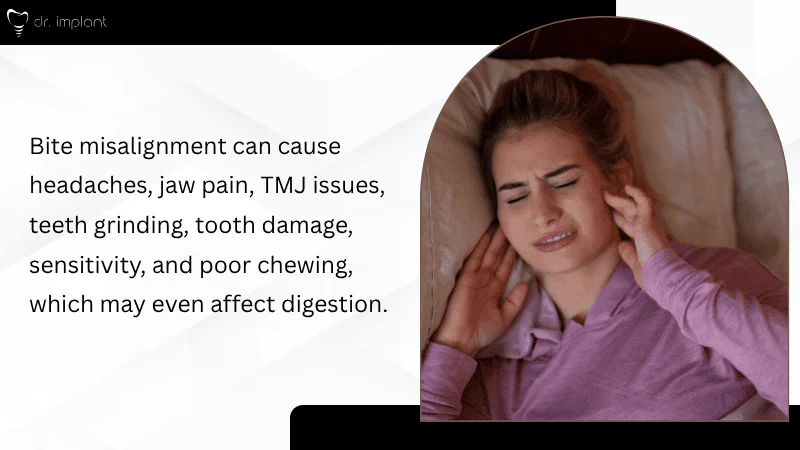
Bite misalignment creates problems that extend far beyond your teeth. You might experience headaches, neck pain, or earaches because your jaw muscles have to work harder to compensate for the improper alignment.
TMJ disorders often develop when bite problems put extra stress on your temporomandibular joint. You may hear clicking or popping sounds when you open your mouth, or you might feel pain while chewing.
Bruxism, or teeth grinding, frequently happens because of bite misalignment. Your body tries to find a comfortable resting position for your jaw, leading to unconscious grinding that wears down your enamel. This can cause:
- Fractured or chipped teeth
- Worn tooth surfaces
- Increased tooth sensitivity
- Loose teeth
Poor chewing efficiency from misaligned teeth can also affect your digestion. When you can’t properly break down food, your digestive system has to work harder.
When Bite Problems Require Full Mouth Rehab
You might need full mouth rehabilitation to restore function and aesthetics when multiple teeth are damaged, missing, or severely worn. Simple fixes like a single crown won’t solve complex bite problems that affect your entire mouth.
Severe bruxism that has worn down most of your teeth often requires comprehensive treatment. Your dentist needs to rebuild tooth structure and correct your bite at the same time to prevent further damage.
If you have multiple missing teeth combined with jaw pain or TMJ disorders, you likely need more than basic dental work.
Full mouth rehabilitation addresses both health and function by treating all problems together in one coordinated plan.
You should consider full mouth rehab if you experience chronic jaw pain, difficulty chewing, or if your teeth no longer fit together properly when you bite down.
Core Components of Full Mouth Rehabilitation
Full mouth rehabilitation combines restorative dentistry, prosthodontics, bite correction, and jaw therapy to rebuild your oral health.
These treatments work together to replace damaged teeth, restore proper chewing alignment, and resolve pain from jaw disorders.
Restorative Dentistry for Damaged and Missing Teeth
Restorative dentistry forms the foundation of your complete mouth restoration by repairing teeth that are decayed, cracked, or worn down.
Your dentist may use dental crowns to cover and protect damaged teeth while restoring their shape and strength. These caps fit over your natural tooth structure and allow you to chew normally again.
When teeth cannot be saved, restorative treatments focus on preparing your mouth for replacement options. This might include root canal therapy, tooth extractions, or bone grafting procedures.
An oral surgeon may need to get involved if you require more complex extractions or need to build up your jawbone.
Veneers and porcelain veneers can restore front teeth that are chipped or discolored. These thin shells bond to your tooth surface and improve both function and appearance.
Your treatment plan depends on how many teeth need repair and the extent of damage present.
Prosthodontics and Tooth Replacement Options
A prosthodontist specializes in replacing missing teeth and restoring bite function through various tooth replacement methods.
Dental implants provide the most stable solution by anchoring artificial teeth directly into your jawbone. These titanium posts fuse with your bone and act like natural tooth roots.
Implant-supported restorations include single crowns, bridges, and full arch replacements. Implant-supported bridges can replace multiple missing teeth without relying on adjacent natural teeth for support.
This approach preserves your healthy tooth structure.
Traditional bridges and partial dentures offer alternatives when implant dentistry isn’t suitable for your situation.
Dentures replace all teeth in an arch and can be conventional or implant-supported for better stability.
Your prosthodontic treatment might combine several replacement methods depending on which teeth you’re missing and your jawbone condition.
Bite Adjustment and Occlusal Rehabilitation
Bite adjustment corrects how your upper and lower teeth meet when you close your mouth.
Poor occlusion causes uneven wear, tooth fractures, and difficulty chewing. Your dentist analyzes your bite pattern to identify contact points that need modification.
Bite correction during full mouth rehab involves reshaping tooth surfaces, adding restorations, or repositioning teeth. This creates balanced contact across all teeth when you chew.
Proper jaw alignment reduces stress on individual teeth and distributes chewing forces evenly.
Occlusal rehabilitation may require adjusting the height of your crowns or other restorations. Your dentist carefully measures and tests your bite throughout treatment to ensure everything fits together correctly.
The goal is a stable, comfortable bite that functions properly for eating and speaking.
Addressing TMJ and Jaw Disorders
TMJ disorders affect the temporomandibular joint that connects your jaw to your skull. Full mouth rehabilitation often includes
TMJ therapy because bite problems and jaw pain are closely connected. Misaligned teeth force your jaw into unnatural positions that strain the joint.
TMJ therapy during your treatment may involve wearing a custom splint or night guard to relax jaw muscles. Your dentist corrects the underlying bite issues that contribute to joint dysfunction.
This dual approach addresses both symptoms and root causes.
Restoring proper bite function through full-mouth rehabilitation can significantly reduce TMJ pain, headaches, and clicking sounds. Your jaw muscles work more efficiently when teeth meet correctly.
Many patients notice their jaw discomfort improves as their bite alignment gets corrected throughout the rehabilitation process.
Comprehensive Assessment and Personalized Treatment Planning
Restoring your bite function starts with detailed digital diagnostics and careful planning by a team of dental specialists.
Your dentist will use advanced imaging tools to map your entire mouth and create a treatment plan designed specifically for your needs.

Digital Diagnostics and Bite Analysis
Your dentist will use digital imaging to get a complete picture of your oral health before starting treatment. CBCT scans provide three-dimensional views of your teeth, jaw, and bone structure.
These scans show much more detail than regular x-rays.
Digital x-rays help your dentist see cavities, bone loss, and problems with existing dental work. Your dentist will also perform a bite analysis to check how your upper and lower teeth meet when you close your mouth.
The diagnostic process typically includes:
- CBCT scan to evaluate bone density and jaw alignment
- Digital photos of your teeth and smile
- Impressions or digital scans of your teeth
- Measurements of your jaw movement and bite position
This information helps your dental team understand exactly what needs to be fixed to restore proper bite function.
Planning a Customized Treatment Approach
Your dentist creates a personalized treatment plan based on the diagnostic results. This plan outlines which procedures you need and in what order they should happen.
The customized treatment plan addresses your specific concerns. Some patients need implant dentistry to replace missing teeth. Others need crowns or bridges to fix damaged teeth.
Your plan might include orthodontics if your teeth need to be moved into better positions. The treatment timeline can range from a few months to over a year depending on how complex your case is.
Your dentist will explain each step and what results you can expect.
Role of Interdisciplinary Dental Teams
Full mouth rehabilitation requires collaboration between dental specialists who each bring different skills to your treatment. A prosthodontist often leads the team and handles the final restorations that rebuild your bite.
An orthodontist may adjust tooth positions before other work begins. A periodontist treats gum disease and performs procedures to support your teeth and implants.
An endodontist performs root canals when needed to save damaged teeth.
This team approach ensures that every aspect of your oral health gets proper attention. The specialists work together to coordinate your care and achieve the best results for your bite function.
Temporary Restorations and Patient Visualization
Your dentist will likely place temporary restorations during treatment to protect your teeth and let you preview your results.
These temporaries show you how your new bite will feel and look before permanent work is completed.
Temporary crowns and bridges let you test your new bite position while eating and speaking. You can tell your dentist if anything feels uncomfortable so adjustments can be made.
Digital visualization tools may show you computer models of your expected results. Some dental offices use photos and mock-ups to help you see what your smile will look like after treatment finishes.
Step-by-Step Procedures That Restore Bite Function
Full mouth rehabilitation follows a structured approach that addresses tooth preservation, structural rebuilding, tooth replacement, and bite alignment.
Each procedure targets specific damage while working together to restore how your teeth meet and function.
Tooth Preservation: Endodontic and Periodontal Therapies
Your dentist starts by saving any teeth that can be preserved. Root canal treatment removes infected pulp from inside your tooth, allowing you to keep the natural tooth structure instead of extracting it.
This endodontic therapy is often necessary when tooth decay reaches deep into the tooth or when trauma damages the nerve.
Periodontal treatment addresses gum disease that threatens the foundation of your teeth. Scaling and root planing cleans beneath your gum line to remove bacteria and tartar buildup.
For advanced cases, bone grafting rebuilds lost jawbone to provide stable support for your teeth.
These foundational treatments create a healthy base for your rehabilitation. Without addressing infection and gum disease first, any restorative work placed on top would likely fail.
Your dentist may also need to treat acid erosion or tooth wear before moving to the next phase.
Rebuilding Tooth Structure: Crowns, Veneers, and Bridges
Once your teeth and gums are healthy, your dentist rebuilds damaged tooth structure. Dental crowns cap entire teeth that have extensive decay or damage, restoring their shape and strength.
These restorations protect weakened teeth while correcting how they align with opposing teeth.
Veneers reshape front teeth affected by wear or minor misalignment. Bridges replace one or several missing teeth by anchoring to adjacent natural teeth.
Your dentist often places temporary dental prosthetics first to test the new bite position and make adjustments before creating permanent versions.
The step-by-step approach includes comprehensive treatment planning that addresses both function and appearance.
Each restoration is designed to distribute bite forces evenly across your teeth, preventing future damage from uneven pressure.
Replacing Teeth: Implants and Dentures
Missing teeth create gaps that cause your bite to shift and remaining teeth to move.
Dental implants replace individual tooth roots with titanium posts that fuse to your jawbone. Crowns or bridges attach to these implants to complete your smile.
For patients missing many teeth, implant-supported dentures offer stability that traditional dentures cannot provide.
These replacements restore your ability to chew properly and prevent the bone loss that occurs when teeth are missing.
Your dentist plans implant placement carefully to ensure they support your bite in the correct position.
The combination of restorative and cosmetic procedures works together to improve chewing function and prevent further dental problems.
Bite Correction: Orthodontics and Night Guards
Orthodontic treatment moves teeth into proper alignment before final restorations are placed. Braces or clear aligners shift your teeth gradually over several months.
This ensures your bite fits together correctly when crowns and other restorations are added.
After your rehabilitation is complete, a night guard protects your investment. This custom appliance prevents damage from bruxism, which is nighttime teeth grinding and clenching.
Many patients grind their teeth without knowing it, wearing down restorations over time.
Your dentist may also recommend a night guard during treatment to protect temporary restorations.
Occlusal equilibration adjusts the biting surfaces of your teeth after final placement to achieve harmonious contact and proper force distribution during chewing.
Long-Term Outcomes and Maintaining Your Restored Bite
Full mouth rehabilitation delivers lasting improvements in how your teeth work together, how comfortable your mouth feels, and how confident you look when you smile.
Success depends on both the quality of your initial treatment and your commitment to proper care afterward.
Results: Restored Function, Comfort, and Smile Aesthetics
Restoring function through full mouth rehabilitation gives you back the ability to chew properly, speak clearly, and bite without discomfort.
Your teeth will meet correctly when you close your mouth, distributing pressure evenly across all surfaces.
The correction of your vertical dimension means your jaw sits at the right height.
This eliminates strain on your jaw muscles and joints that causes headaches and facial pain. Most patients notice reduced tension in their face and neck within weeks of completing treatment.
Your smile aesthetics improve dramatically as worn, damaged, or missing teeth get replaced with carefully designed restorations.
The new teeth match the shape and color of natural teeth while supporting your lips and cheeks properly. This creates a more youthful appearance and gives you a confident smile you’ll want to show off.
Implant-supported restorations last 15-25 years with success rates above 95% according to long-term studies. Other types of restorations also provide excellent durability when properly maintained.
Maintenance, Follow-Up, and Preventing Recurrence
Daily care routines protect your investment:
- Brush twice daily with a soft-bristled toothbrush
- Floss around all restorations and natural teeth
- Use water flossers for hard-to-reach areas around bridges and implants
- Avoid chewing ice, hard candies, or other objects that could crack restorations
Professional cleanings every six months remove buildup that regular brushing misses. Your dentist checks for early signs of problems like loose restorations, gum inflammation, or bite changes during these visits.
Regular check-ups and lifestyle habits keep your oral health strong for decades. If you grind your teeth at night, wearing a custom nightguard prevents damage to your new restorations.
Your dentist may adjust your bite periodically as your mouth naturally changes over time.
Enhancing Confidence and Quality of Life
Your ability to eat the foods you love returns after treatment. No more avoiding crunchy vegetables, chewy meats, or your favorite snacks because of pain or embarrassment.
Social situations become easier when you’re not worried about gaps in your smile or loose teeth. You can laugh freely, speak without mumbling, and make eye contact without feeling self-conscious.
The transformative potential of full mouth rehabilitation extends beyond dental care into your overall wellbeing. Many patients report feeling more outgoing at work and in personal relationships.
Better nutrition from proper chewing supports your general health too.
The smile makeover effect often motivates people to take better care of their overall health. When you see the positive results in the mirror every day, maintaining good habits becomes much easier.
Frequently Asked Questions
Full mouth rehabilitation addresses complex dental issues through planned treatment phases. Understanding bite height measurements, digital planning tools, and treatment timelines helps you prepare for the process ahead.
How does full mouth rehabilitation improve chewing efficiency and comfort?
Full mouth rehabilitation restores your ability to chew by fixing worn, broken, or missing teeth that make eating difficult.
When your teeth don’t meet properly, you may struggle to break down food or experience pain while chewing.
The treatment rebuilds your teeth to work together as a complete system. This means your upper and lower teeth align correctly when you bite down. You’ll be able to chew food more easily and without discomfort.
Many people also notice they can eat a wider variety of foods after treatment. Hard or chewy foods that were once difficult become manageable again.
What are the signs that my bite problem might require full mouth rehabilitation?
You might need full mouth rehabilitation if you have multiple dental problems affecting several teeth at once. Common signs include severe tooth decay in multiple areas, missing teeth, or teeth that are heavily worn down.
Jaw pain or clicking sounds when you open and close your mouth can indicate bite issues. You may also notice that your face looks shorter or more collapsed than it used to.
Difficulty chewing or speaking clearly points to problems with how your teeth come together. If you have old dental work that’s broken or failing in several places, rehabilitation might be the best option.
How do dentists determine the correct bite height during treatment?
Your dentist measures your bite height by examining how far apart your jaws are when your teeth are together. They look at your facial proportions and the natural position of your jaw joints.
Photos and X-rays help show where your teeth used to be before they wore down. Your dentist also checks the position of your jaw when your muscles are relaxed.
Special tools measure the space needed for new restorations. These measurements ensure your new teeth will support your jaw properly and look natural with your facial features.
How is the bite raised safely in a full mouth rehabilitation plan?
Raising your bite happens gradually through careful planning and testing. Your dentist may create temporary restorations that let you try out the new bite height before making permanent changes.
The process involves adding height to your back teeth first. This creates support for your jaw and prevents stress on your front teeth.
Your dentist monitors how your jaw joints and muscles respond to the changes. If you experience any discomfort, adjustments can be made before the final restorations are placed.
This step-by-step approach helps your body adapt to the new bite position safely.
What role does digital dentistry play in planning and restoring a stable bite?
Digital dentistry uses computer technology to plan your treatment before any work begins. Scanners create 3D images of your teeth and jaw that are more accurate than traditional impressions.
Software allows your dentist to design your new smile on a computer screen. You can see what your teeth will look like and how they’ll function together.
These digital plans guide the creation of your restorations with precision. The technology helps ensure your new teeth fit correctly and maintain a stable bite over time.
What does a typical full mouth rehabilitation case involve from diagnosis to final restorations?
A typical full mouth rehabilitation case starts with a complete exam of your teeth, gums, jaw joints, and bite. Your dentist takes X-rays, photos, and detailed measurements to understand all your dental problems.
The planning phase involves creating a treatment plan that addresses your issues in the right order. Your dentist may need to treat gum disease or perform extractions before rebuilding your teeth.
You’ll likely receive temporary restorations to test the new bite and appearance. This lets you adjust to the changes and provide feedback before final restorations are made.
The timeline can take several months to over a year, especially if dental implants or bone grafting are needed. Final restorations like crowns, bridges, or veneers are placed once your bite is stable and your gums are healthy.