Full-arch implant rehabilitation (e.g. “All‑on‑4/6” fixed prostheses) is increasingly used to replace edentulous jaws.
It involves placing multiple implants (often four per arch) with immediate loading of a fixed bridge. Recent evidence shows that modern full-arch protocols yield high long-term implant survival.
For example, one systematic review of contemporary implants found a 10‑year implant-level survival of ~96.4%. Similarly, All-on-4 studies report very high survival (e.g. 95.7% at 13 years for maxillary arches, 91.7% at 18 years for mandibles).
Even in severely atrophic maxillae treated with zygomatic implants, 10‑year implant survival exceeds 95%. In general, long-term implant retention is excellent in specialist hands.

Learn the full arch dental implant success rate and explore long-term results
10-Year Implant Survival: Across large cohorts, implant survival at 10 years typically exceeds 90–95%. Howe et al. (2019) meta-analyzed 18 prospective studies and found a pooled 10-year survival of 96.4% (implant level).
In All-on-4 cases, Nobre et al. (2022) reported cumulative implant survival of 94.1% at 10 years (patient-level) – equivalent to 96.2% at implant level.
Similarly, Maló’s original All-on-4 data showed 95.7% 13-year survival (maxilla) and 91.7% at 18 years (mandible).
In zygomatic implant protocols for atrophic maxillae, Aparicio et al. (2014) observed 10‑year implant survival of 97.7% for regular implants and 95.1% for zygomatic implants.
These figures indicate that even complex full-arch cases can achieve implant longevity comparable to single-tooth implants.
Prosthesis Survival and Complications: Implant survival does not guarantee complication-free prosthesis. Technical and material failures accumulate over time.
A recent retrospective series found that cumulative prosthesis survival dropped to 80% at 5 years and only ~60% at 10 years.
In practice, nearly all full-arch prostheses require at least one repair by 6 years (100% had ≥1 minor complication by year 6).
Complications include acrylic or ceramic fractures, veneer chipping, screw loosening or de-cementation.
In one long-term comparison, all-ceramic bridges survived better than acrylic hybrids: the 10-year survival of maxillary ceramic prostheses was 90.6% versus 73.7% for acrylic (“Toronto”) bridges.
However, overall patient-level “success” (failure-free survival) at 10 years was only ~60–70% for both groups, reflecting frequent maintenance needs.
Thus, while implants remain stable, the superstructure often requires intervention (repair or remake) in the long term.
Biological Complications and Re-treatment: Long-term biological issues also arise. Peri-implantitis (inflammatory bone loss around implants) and mucositis become increasingly common with time.
Although exact 10-year rates vary by study, multi-center reports suggest on the order of 10–20% of implants may suffer peri-implantitis by 10 years.
For example, one prospective cohort found ~7% of patients had peri-implantitis after 10 years of follow-up (with an overall implant survival of ~99%). Peri-implantitis often necessitates re-treatment (debridement or even implant replacement).
Notably, All-on-4 protocols still show low overall implant loss even when implants are placed in challenging sites, indicating that diligent maintenance can control disease.
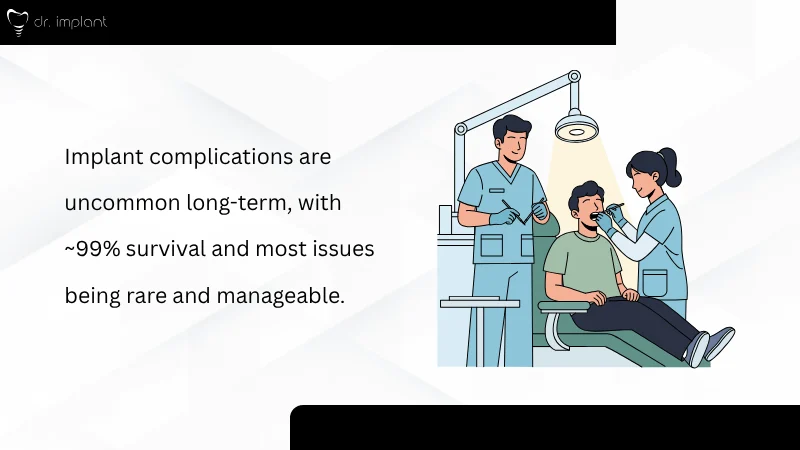
In practice, implant failure is uncommon (when early failures are replaced immediately).
For instance, Crespi et al. reported 5 early failures (implants lost before loading) out of 860 total implants, all of which were replaced successfully, and 20 implants lost after 10 years – a very low absolute rate.
When failures do occur (often due to peri-implantitis or overload), patients can often be re-treated by placing new implants adjacent to the failed ones.
Contact us to learn more about full arch implant outcomes and options.
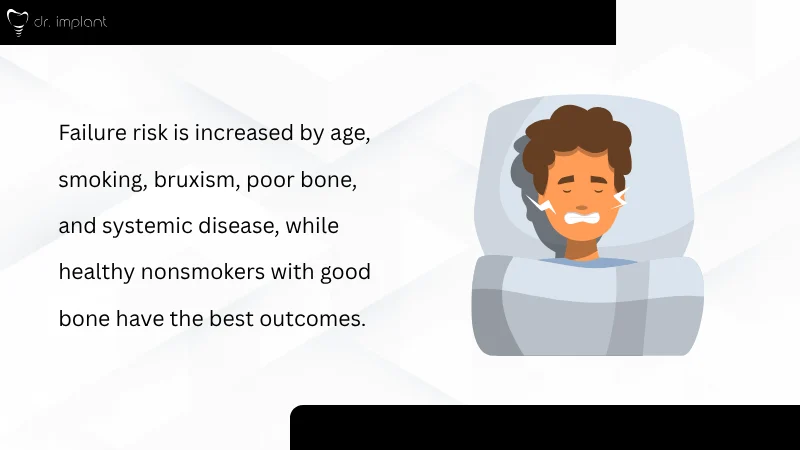
Risk Factors for Failure: Several patient and procedural factors affect outcomes.
Age: Older patients have modestly higher failure risk. Meta-analysis shows patients ≥65 years had lower 10-year implant survival (~91.5%) than younger cohorts.
Smoking: Tobacco use significantly impairs survival. In the MDPI 10-year All-on-4 study, smokers had a higher failure rate (p=0.019).
Bruxism/parafunction: Heavy clenching increases mechanical stress; bruxism was linked to more prosthetic chipping and a higher complication rate.
Bone Quality: Maxillary (softer bone) prostheses generally show slightly lower survival than mandibular, as reflected in the lower survival (73.7%) of maxillary acrylic bridges vs mandibular (87.5%).
Systemic Health: Diabetes and osteoporosis can subtly increase risk (though well-controlled diabetics often do as well as nondiabetics).
Design Factors: Prosthesis design matters – e.g. ceramic bridges have higher rigidity and survival than acrylic, but acrylic may be easier/cheaper to repair.
In summary, ideal candidates are younger nonsmokers with good bone; high-risk patients require careful monitoring.
Patient Outcomes: Despite complications, patient satisfaction remains high. In one long-term report on zygomatic/full-arch cases, 84% of patients reported ≥80% satisfaction with their rehabilitation at 10 years.
Outcomes such as chewing ability and aesthetics are consistently excellent, which drives the popularity of full-arch solutions in rehabilitative dentistry.
Regional Context – U.S. and Florida: In the U.S., demand for full-arch implants is strong but uneven. States like California and Florida place the most implants by volume.
Florida’s demographics amplify this demand: 21.8% of Florida’s residents are age ≥65 (versus ~18% US-wide), and older age correlates with higher tooth loss.
Florida also has a large pool of specialists (Miami and South Florida are major referral centers) and dental tourism for comprehensive implants.
However, access is still a concern: nationally there are ~59.5 dentists per 100,000 people, while Florida has only ~29.3/100k (ranked ~35th).
Lower dentist density (and fewer specialists in rural areas) could limit access to advanced implant care in some parts of Florida.
Patients in outlying communities like Delray Beach or Pembroke Pines must often travel to urban centers (Miami, Tampa, etc.) for care by experienced teams.
Cost is another barrier: most full-arch implants are privately funded (Medicaid in Florida generally does not cover implants).
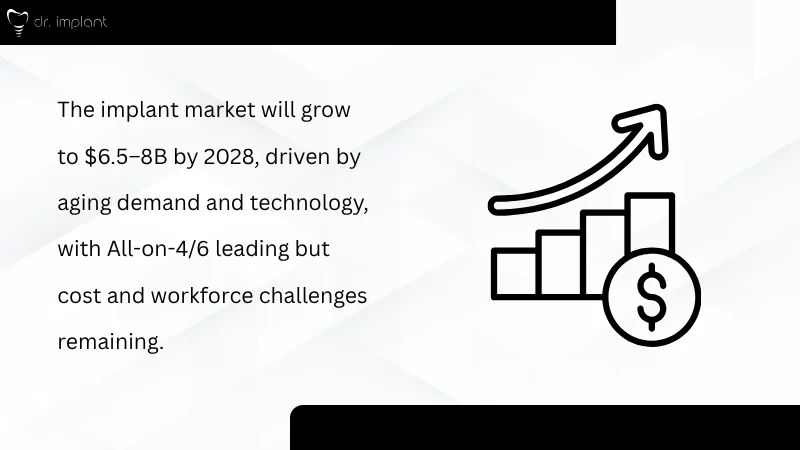
Future Trends (Post-2026): The outlook is one of continued growth and innovation. Analysts project the global dental implant market to reach $6.5–8.0 billion by 2028 (≈6.3% annual growth).
Demand is driven by aging populations and rising esthetic expectations. In the U.S., the Baby Boomer generation aging into retirement will keep implant demand high.
Technological advances will further improve outcomes: digital imaging and guided surgery increase placement accuracy; CAD/CAM and AI algorithms optimize prosthesis design; and new materials (e.g. zirconia implants or reinforced polymers) aim to reduce complications.
We expect immediate-loading protocols (All-on-4/6) to remain dominant for full arches due to efficiency, but alternatives like zygomatic implants will be used more often for severe maxillary atrophy (as long-term data here is robust).
Tele-dentistry and expanded dental therapy may improve patient access to specialist planning. However, challenges persist – notably a projected shortage of trained implant surgeons and high out-of-pocket costs.
Summary for Clinicians: In summary, current evidence indicates that full-arch implant rehabilitation yields high long-term implant survival (~94–97% at 10 years).
Success depends on managing risk factors (age, smoking, bruxism) and planning for maintenance. Prosthetic complications are common and expected, so patients should be counselled about the need for periodic repairs.
In Florida’s context, clinicians should note the large older patient base and ensure rigorous follow-up protocols.
Future improvements (digital workflows, better materials) promise incremental gains, but the core message remains: full-arch implants are a durable solution with excellent 10-year outcomes when placed and maintained by experienced teams.
References: Peer-reviewed clinical studies and systematic reviews were cited throughout: implant survival meta-analyses, All-on-4 clinical series, comparative full-arch outcomes, and long-term zygomatic implant data.
Industry forecasts provide market context, and authoritative sources (ADA HPI, CDC data) inform regional demographics. These collective findings underpin the above guide for clinicians and researchers.
The Long-Term Use of Zygomatic Implants: A 10-Year Clinical and Radiographic Report
Explore Population – Age 65+ in Florida | AHR
Dentist Workforce | American Dental Association
Global Dental Implants Market Valuation to Reach $6.48 Billion by 2028 – Dentistry Today