Prevalence of Tooth Loss
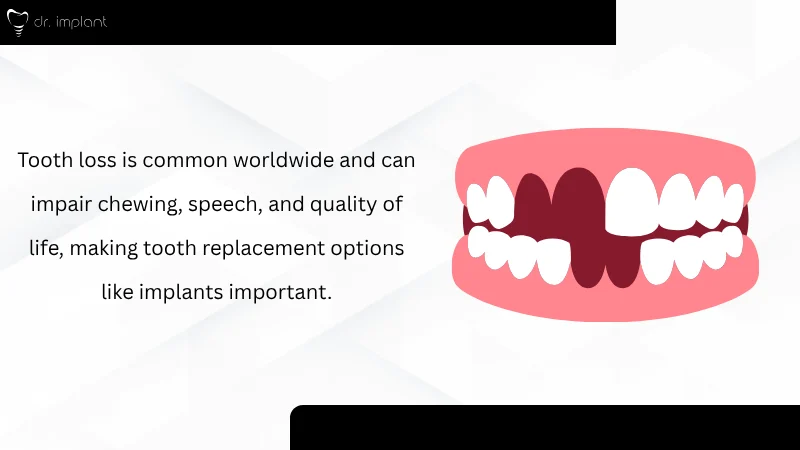
Tooth loss is common globally and in the U.S. In the U.S., about 13.2% of adults aged ≥65 are completely edentulous (no natural teeth).
Studies also show 33.0% of U.S. seniors (65+) have lost six or more teeth, and an estimated 178 million Americans are missing at least one tooth.
Worldwide, roughly 3.5 billion people suffer from oral diseases; among them, nearly 23% of seniors lack all teeth (about 350 million people).
The cost benefit of dental implants disproportionately affects the elderly and low-income groups, and tooth loss impairs chewing, speech, nutrition, and social interactions.
For example, CDC notes that retaining at least 20 teeth is needed for normal chewing and speech, so even partial loss “can compromise… essential functions and diminish quality of life”.
Economic Consequences of Tooth Loss
Untreated tooth loss and decay impose large costs.
Globally, oral conditions (caries, periodontal disease, tooth loss, etc.) cost an estimated $710 billion in 2019, including $387 billion in direct treatment and $323 billion in productivity losses.
WHO data indicate over $380 billion was spent worldwide on major oral diseases in 2019. In the U.S., untreated dental caries alone caused an estimated $45.9 billion in lost workplace productivity (2015).
Missing teeth often lead to reduced diet quality, emergency visits and systemic health impacts (e.g. nutritional and psychological issues), which likely add further indirect costs.
For disadvantaged populations, lack of dental insurance means many forgo care, exacerbating long-term costs. Overall, these figures highlight that preventing or effectively treating tooth loss can avoid substantial societal costs.
Replacement Options and Costs
Once teeth are lost, replacement options include fixed vs removable dentures, bridges, and dental implants. Key cost considerations include initial procedure fees, long-term maintenance, and replacement frequency.
· Removable Dentures: These have the lowest initial cost. In the U.S., a single arch of full removable dentures typically costs US$1,500–3,000.
However, dentures require regular adjustments, adhesives, and replacement every 5–10 years. One estimate notes most removable dentures run $500–10,000 depending on quality.
They also provide minimal jawbone stimulation, often leading to gradual bone loss (which can later increase costs if implants are eventually needed).
· Fixed (Tooth‑supported) Bridges: A traditional 3‑unit bridge (replacing one tooth by crowning adjacent teeth) costs roughly $2,000–4,000 in many U.S. practices (varies widely).
Like implants, bridges restore chewing function without daily removal, but they shorten adjacent teeth and may fail over time.
Some analyses find root canal + crown is cheaper than extraction + implant for a single tooth, so preserving a heavily decayed tooth can sometimes be more economical than replacing it.
· Dental Implants: Dental implants (surgical titanium posts plus abutment and crown) are the most expensive upfront.
In South Florida (Pembroke Pines/Miami area), clinics quote about $3,000–5,000 per single tooth implant (post + abutment + crown).
Larger cases (splinted multi‑tooth implants) cost more, and full-arch solutions can reach $15,000–25,000+ per arch. Nationally, figures of $3,400–5,000 for a single implant are cited.
While high, implants last decades: published rates show 95–98% success over 10+ years, and most patients avoid recurrent repair costs (no relines or adhesives).
Hence many providers emphasize that, although dentures are cheaper initially, implants typically “deliver strong long-term value” and often become more cost-effective over time.
Cost–Benefit and Cost-Effectiveness Findings
Recent economic studies compare these options:
· Implants vs Dentures (Full‑arch): One U.S. dental practice analysis (South Florida) estimated fixed full-arch restoration at $20,000–50,000 per arch, versus $500–10,000 for removable dentures.
The practice noted that removable dentures typically require frequent replacement and maintenance (thereby raising lifetime costs).
In long-term models, implants’ higher upfront cost is offset by fewer recurring costs (no adhesives, relines, etc.) and by preventing bone loss (which can require bone grafting later).
In summary, despite dentures’ lower sticker price, implants often “become the more cost-effective option over time”.
· Implants vs Bridges (Single Tooth): A 2016 review concluded most studies find single implants more cost-effective than 3‑unit bridges.
For example, a 2021 cost-utility model showed a single implant crown provided 15.31 quality-adjusted “prosthesis” years over 30 years, with an incremental cost-utility ratio of, $1,434 (negative, meaning implants were both less costly and more effective) compared to a 3‑unit bridge.
The authors concluded that a single-tooth implant “is more cost-effective” than an equivalent fixed bridge.
· Implants vs Conventional Dentures (Full Mouth): A (2019) study compared implant‑supported lower dentures to conventional complete dentures.
Over 20 years, the implant solution had a very favorable cost-effectiveness ratio well below the willingness-to-pay threshold. In other words, in that public-health context implant-supported dentures were found highly cost-effective compared to standard dentures.
· Periodontal Disease Context: By contrast, a 2023 systematic review of severe periodontal patients found that treating and maintaining diseased teeth cost less than extraction with implant replacement.
In other words, implants in the setting of active gum disease proved more expensive overall than periodontal therapy with prosthetic retention. This underscores that clinical context matters: if teeth are salvageable, implants may not be the cheapest route.
Local (Florida) Context
No comprehensive public data are available for Pembroke Pines, Delray Beach or Miami specifically. However, South Florida dental practices report pricing and coverage patterns that inform local economics.
For example, Florida clinics typically quote $3–5K for a single implant (similar to national averages) and $15–25K per implant-retained full arch. By contrast, Florida denture costs (removable) run on the order of $1.5–3K per arch.
Many Florida dentists offer financing and specials (e.g. promotional bundles) due to high competition. Insurance coverage is a major factor:
Medicare generally does not cover routine dental or dentures, so elderly patients often pay out-of-pocket or via Medicaid (where available).
Specialty Medicaid in Florida is very limited, so high-income patients or those with supplemental plans are more likely to receive implant care.
Dentist density in South Florida is high, and providers there note a growing older population with demand for implants.
Market reports project that the U.S. implant market, already about $2.12 billion in 2024, will grow to $3.15 billion by 2030. This likely reflects both technological advances and patient willingness to invest in dental health.
Market Trends and Forecasts

The dental implant sector is expanding. Globally the implants/oral prosthetics market is projected to rise from about $12.6 billion in 2025 to $18.8 billion by 2030.
In North America, the U.S. is dominant: one analysis projects U.S. implant revenue growing from $2.12 billion in 2024 to $3.1 billion by 2030.
Factors include an aging population (more seniors losing teeth), rising oral health awareness, and innovations (e.g. faster “teeth-in-a-day” protocols).
Dental tourism also fuels growth; with high U.S. prices, many patients travel abroad for implants (in 2032 the dental tourism market is forecast at ~$24.2B).
Overall, implants are gaining share: about 33% of general dentists now place implants themselves, and approximately 3 million implants are placed annually in the U.S.
These trends imply that implant rehabilitation will continue to account for a larger share of dental spending.
From an economic perspective, this could mean higher overall costs if implants substitute for less expensive options.
However, if implants reduce other health burdens (e.g. malnutrition, co-morbidities) or improve productivity, they may justify their costs.
Decision analyses suggest that, at least for many patients, the health benefits and longevity of implants can outweigh the extra expense over time.
Conclusions
Tooth loss carries high economic costs, both direct dental expenditures and broader impacts on productivity and health. Dental implants offer a durable solution to missing teeth, but with high initial expense.
In the long run, many analyses find implants often provide better value than bridges or removable dentures, especially when accounting for maintenance and quality-of-life gains.
For example, implant-supported crowns and dentures frequently emerge as cost-effective or even cost-saving relative to traditional alternatives in recent studies.
However, implant therapy is not always the cheapest per se, in certain clinical scenarios, preserving teeth is more economical.
In South Florida (Pembroke Pines/Delray/Miami), implant prices align with national norms, and competitive dental markets may offer financing or discounts.
Nonetheless, the economic impact is similar: implants impose higher out-of-pocket costs but promise longer-term benefits.
Given the projected growth of the elderly population and implant market, dental providers and policymakers should weigh strategies to make implant care cost-effective (e.g., insurance coverage, preventive maintenance) versus more affordable dentures.
In sum, the cost–benefit landscape shows that while tooth replacement is expensive, investing in implants can yield substantial long-term advantages in function and health.
Future trends (through 2026 and beyond) will likely see continued innovation in implant therapy and possibly broader adoption, potentially shifting economic burdens from removable prostheses toward implant rehabilitation as evidence of value accumulates.
Contact us today to schedule a consultation with an expert and explore affordable treatment plans.
Sources: Authoritative data and studies from CDC, WHO, peer-reviewed journals, and industry analyses were used, including CDC oral health reports, WHO economic data, and recent cost–effectiveness research.
These were supplemented by regional pricing information from Florida dental clinics.
References
FastStats – Oral and Dental Health
Oral Health | Chronic Disease Indicators | CDC
Does Medicare Cover the Cost of Dentures?
(PDF) Cost-utility analysis of an implant treatment in dentistry